Course materials are available. Sign-in, submission checking and saved learning records are not open yet. You can read, watch, download and prepare answers in this tab; answers are not saved.

MATH-100 · Lesson 3 of 4

Variables, Equations and Economic Formulas

Translate short economic descriptions into algebra, solve linear equations and inequalities, rearrange formulas and check whether a solution makes sense.

Allow approximately 85 minutes, including exercises. Work at your own pace.

What you will learn

  • Distinguish variables, constants, expressions and equations.
  • Substitute numerical values and use brackets and order of operations correctly.
  • Solve linear equations and inequalities while preserving valid solutions.
  • Rearrange simple cost and profit formulas, respecting units and domain restrictions.

Watch and work along

Narrated walkthrough

This 11-minute video works through every slide using a clearly identified generic synthetic narrator. It is not a recording of Craig Wright. Captions are always visible below the slide. Pause whenever you need time to calculate. On a small screen, use full-screen playback or the readable text below.

Jump to a slide in the video

The complete lesson

Slide-by-slide walkthrough

Read each slide, follow its explanation, and pause at the examples. The text below supplies the complete written walkthrough, so you can read and recalculate at your own pace.

Slide 1 / 14

Letters stand for quantities

A variable is a symbol whose value can change or is not yet known. A constant is held fixed within the problem. In C = 18 + 6q, q represents quantity and C represents total cost in pounds. The fixed charge is £18 and the cost per unit is £6. Writing 6q means 6 × q.

Walkthrough and explanation

Algebra does not replace arithmetic with a new kind of mystery. It lets us describe the same calculation before choosing particular numbers. If quantity changes, the formula tells us how total cost changes. A letter needs a definition just as a number needs a unit. Here q counts units and C measures pounds, so the coefficient six has the meaning pounds per unit. A coefficient is the number multiplying a variable. Constants are fixed only within the stated model: a different supplier or a different period could have a different fixed charge or unit cost.
Next slide

Slide 2 / 14

Expressions, equations and solutions

An expression, such as 3x + 7, describes a calculation. An equation, such as 3x + 7 = 22, states that two expressions have equal values. A solution is a value that makes the equation true. A linear equation contains variables only to the first power, with no products between variables.

Walkthrough and explanation

An expression has no equals sign and does not by itself ask you to find a particular value. An equation adds a condition. Our example asks which value of x makes three times x plus seven equal twenty-two. The answer is not established merely by producing a number; it must satisfy the condition when substituted back. “Linear” will later connect to a straight-line graph. For now, notice that x squared and a product such as x times y would take us beyond the simple linear relationships in this lesson. We begin with one unknown so each step is easy to inspect.

Next slide

Slide 3 / 14

Brackets and the order of operations

Calculate brackets first, then powers, then multiplication and division, then addition and subtraction. Operations at the same level are evaluated from left to right. Distributing multiplication gives 3(x + 2) = 3x + 6. Collect like terms only: 4x + 2x = 6x, but 4x + 2 cannot be combined into 6x.

Walkthrough and explanation

Brackets show which pieces belong together. Three times the whole expression x plus two means three copies of x and three copies of two. Missing the second multiplication is a common error. Like terms contain the same variable part, so four x plus two x counts six copies of x. A plain two is a different kind of term and stays separate. To see why, try x equal to ten: four x plus two gives forty-two, whereas six x gives sixty. For division involving a whole expression, use brackets explicitly, as in (C minus F) divided by v.

Next slide

Slide 4 / 14

Substitution turns a formula into arithmetic

Substitution means replacing a symbol with its stated value. For C = 18 + 6q and q = 4, calculate C = 18 + 6 × 4 = 18 + 24 = £42. Multiply before adding. Check units: pounds plus pounds per unit multiplied by units gives pounds, as required for total cost.

Walkthrough and explanation

Write a separate substitution line rather than trying to jump directly to the answer. This makes the chosen value and the order of operations visible. Six times four comes before adding eighteen because multiplication takes priority over addition. The unit check is equally important: six pounds per unit times four units gives twenty-four pounds, which can legitimately be added to the eighteen-pound fixed charge. If your formula tried to add pounds directly to a count of units, that would signal a modelling problem even if the arithmetic were possible. Substitution is also the main tool for checking an equation after solving it.

Next slide

Slide 5 / 14

Preserve the balance of an equation

To solve an equation, use operations that preserve equality. Add or subtract the same quantity on both sides; multiply or divide both sides by the same non-zero number. For 3x + 7 = 22, subtract 7: 3x = 15. Divide by 3: x = 5. Check: 3 × 5 + 7 = 22.

Walkthrough and explanation

Imagine the equals sign as a balanced relationship. Changing just one side generally destroys that balance, while applying the same valid operation to both sides preserves it. We undo addition before multiplication here because seven was added after three multiplied x. Subtracting seven removes that outer operation, leaving three x. Dividing by three isolates x. “Move it across and change the sign” can be a shorthand, but it hides the reason the step works. Write the operation on both sides while learning. Dividing by zero is never valid, and dividing by an unknown expression requires checking whether it could be zero.

Next slide

Slide 6 / 14

Unknowns can appear on both sides

For 5x + 7 = 2x + 22, subtract 2x from both sides: 3x + 7 = 22. Subtract 7: 3x = 15. Divide by 3: x = 5. Check both original sides: 5 × 5 + 7 = 32 and 2 × 5 + 22 = 32.

Walkthrough and explanation

The same balance rule works when x appears on both sides. Subtracting two x removes the right-hand variable term and leaves three x on the left. We then proceed as before. The checking stage should use the original equation, because an accidental mistake in an intermediate line could otherwise be carried into the check. Both original sides evaluate to thirty-two, so the condition holds. You could instead subtract five x first and work with negative coefficients. That route is also valid. Choose a clear route, but remember that correctness comes from preserving equality rather than following one compulsory sequence.

Next slide

Slide 7 / 14

Inequalities describe ranges of answers

An inequality compares sizes: < means less than, ≤ means less than or equal to, > means greater than, and ≥ means greater than or equal to. Adding the same quantity preserves the sign. Multiplying or dividing by a negative number reverses it: −2x < 6 becomes x > −3 after division by −2.

Walkthrough and explanation

An equation often identifies a particular value, while an inequality can identify a whole range. The strict symbols exclude the boundary; the symbols with the extra line include it. The sign reversal is easiest to understand on the number line. Two is less than five, but multiplying both by minus one gives minus two, which is greater than minus five. Negative multiplication reverses order. In our algebra example, division by minus two therefore turns “less than” into “greater than”. Test a value from your proposed range in the original inequality. Zero works here, while minus four does not, which supports the direction we found.

Next slide

Slide 8 / 14

Worked example: turn a cost question into an equation

A fictional workshop charges £18 for setup and £6 per unit. A total bill is £90. Let q be the number of units, so 18 + 6q = 90. Subtract 18 from both sides: 6q = 90 − 18 = 72. The £72 remaining covers only the per-unit charges.

Walkthrough and explanation

We already know the structure of this cost model, but now the total is known and quantity is unknown. State q clearly before forming the equation. The setup charge appears once, while six pounds is charged for each unit. Subtracting eighteen pounds removes the fixed component from both sides. This leaves seventy-two pounds available to cover the quantity-dependent component. Do not divide ninety by six immediately, because that would incorrectly treat the setup charge as if it purchased units. Keep the economic interpretation beside the algebra: six pounds per unit multiplied by q units must equal the remaining seventy-two pounds.

Next slide

Slide 9 / 14

Worked example: solve, check and interpret

From 6q = 72, divide both sides by 6: q = 72 ÷ 6 = 12 units. Check the original bill: £18 + £6 × 12 = £18 + £72 = £90. The result is a whole, non-negative quantity, so it fits this workshop model as well as satisfying the equation.

Walkthrough and explanation

Dividing the remaining seventy-two pounds by six pounds per unit yields twelve units. The pounds cancel in the rate calculation, leaving a count of units rather than another money total. Now rebuild the original bill: twelve units cost seventy-two pounds, and adding the eighteen-pound setup charge gives ninety pounds. This independent reconstruction is stronger than simply repeating the division. We also check the permitted domain, meaning the values the variable is allowed to take. If the workshop sells only complete units, a negative answer or a fraction of a unit would need further interpretation rather than automatic acceptance.

Next slide

Slide 10 / 14

Worked example: model revenue, cost and profit

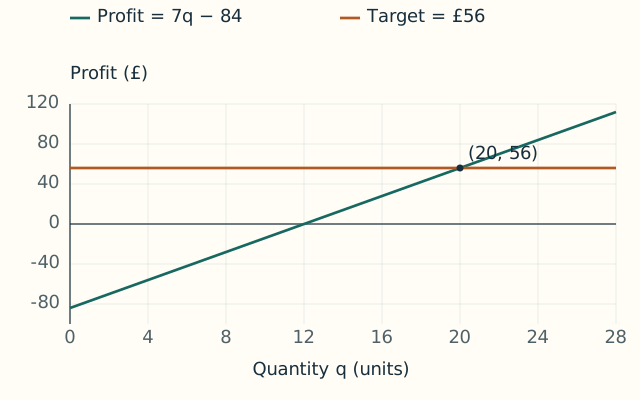
An invented business receives £18 per unit sold, pays £11 per unit in variable costs and has £84 in fixed costs. Revenue R = 18q; cost C = 84 + 11q. Profit π means revenue minus cost: π = 18q − (84 + 11q) = 18q − 84 − 11q = 7q − 84.

Walkthrough and explanation

The Greek letter pi is simply a label for profit here; it is not the circle constant in this formula. Revenue is money received from sales. Variable cost changes with output, while fixed cost is held constant over the modelled range. Subtract the whole cost expression from revenue, which is why the brackets matter. Removing the brackets changes both cost terms to negatives. Collecting eighteen q minus eleven q leaves seven q, then subtract the fixed eighty-four pounds. Each additional unit contributes seven pounds towards fixed cost and then profit, assuming every unit produced is sold at the stated price.

Next slide

Slide 11 / 14

Worked example: meet a minimum profit target

Require profit of at least £56: 7q − 84 ≥ 56. Add 84 to both sides: 7q ≥ 140. Divide by positive 7: q ≥ 20. Check q = 20: revenue = £360, cost = £84 + £220 = £304, profit = £56. At least 20 whole units are required under the model.

Profit reaches the £56 target at 20 units; larger feasible quantities exceed it.
Walkthrough and explanation

The phrase “at least” includes the target itself, so we use greater than or equal to rather than a strict inequality. Adding eighty-four to both sides gives seven q greater than or equal to one hundred and forty. We divide by positive seven, so the direction stays unchanged. Twenty is the smallest permitted whole quantity. Reconstructing revenue and cost at twenty verifies the boundary. At nineteen units, the formula gives forty-nine pounds of profit, below the target, so nineteen is insufficient. The conclusion depends on the model assumptions, including constant prices, constant unit costs and no unsold output or capacity restriction.

Next slide

Slide 12 / 14

Rearrange formulas before inserting numbers

Rearranging makes a chosen variable the subject, meaning it stands alone on one side. Starting from C = F + vq, subtract F: C − F = vq. Divide by v: q = (C − F)/v, provided v ≠ 0. To isolate v instead, divide by q: v = (C − F)/q, provided q ≠ 0.

Walkthrough and explanation

The letters now represent general quantities: C is total cost, F is fixed cost, v is variable cost per unit and q is quantity. The same balance operations apply even when the numbers are not yet supplied. Brackets around C minus F are essential: the whole difference is divided by v or q. Making a general formula first can reduce repeated work when several scenarios use the same structure. State the non-zero condition for each denominator. If no units are produced, total cost alone cannot reveal variable cost per unit, because the variable-cost term contributes nothing regardless of its coefficient.

Next slide

Slide 13 / 14

Mathematical answers need domain checks

The domain is the set of values allowed for a variable. Counts of indivisible products are usually non-negative whole numbers; hours or mass may be fractional. An inequality such as q ≥ 6.2 requires at least 7 whole products. Equations can also have no solution or many solutions, so do not force every problem into one numerical answer.

Walkthrough and explanation

Suppose an algebraic lower bound is six point two and products cannot be divided. Six is too small, so round upwards to seven, rather than using ordinary nearest-integer rounding. An upper bound of six point two would allow at most six whole products. Context decides the direction. Sometimes simplification removes the unknown entirely. If it leaves zero equals three, no value can satisfy the original equation. If it leaves zero equals zero, every value in the permitted domain satisfies it, provided no earlier operation excluded a valid case. Checking these outcomes prevents a calculator-looking answer from replacing actual reasoning.

Next slide

Slide 14 / 14

An algebra routine you can explain

Define each symbol and its units. Translate the words into an equation or inequality. Simplify carefully, apply the same valid operation to both sides, and reverse inequality signs when dividing or multiplying by negatives. Substitute the result into the original relationship. Finally, apply whole-number, non-negativity or other restrictions required by the scenario.

Walkthrough and explanation

The aim is not to memorise a separate trick for each question. A small set of balance rules solves many problems once the situation is represented accurately. Read words such as “exactly”, “at most” and “at least” carefully: they determine whether you need equality or an inequality, and which direction it faces. Keep one operation per line until the process feels natural. For the exercises, retain your working even when the form asks only for a boundary or a number. You should be able to say why the result works and why values outside an inequality range fail the condition.

Go to the exercises

Questions students ask

This guided dialogue explains common sticking points. It is written teaching material, not a live chat service.

Is 6q the same as 6 + q?

No. Writing a coefficient beside a variable means multiplication. If q is four, 6q is twenty-four, while 6 + q is ten. Write the multiplication sign explicitly whenever the shorthand feels unclear.

Why does subtracting a bracket change every term inside it?

Subtracting an expression is multiplying that entire expression by negative one. Thus a − (b + c) = a − b − c. Apply the negative to both terms, rather than only the first.

Must I reverse an inequality whenever I see a negative number?

No. Reverse the sign only when multiplying or dividing both sides by a negative quantity. Adding or subtracting a negative number does not by itself reverse the ordering.

Why might a correct algebraic result still be unsuitable?

The situation can impose additional restrictions. Products may need whole-number counts, quantities may be non-negative, and a cost formula may apply only within a stated capacity. Check those conditions after solving.

Can I divide both sides by an unknown variable?

Only after accounting for the possibility that it is zero. Dividing by a variable without checking can discard a valid zero solution or perform an undefined operation. In these introductory formulas, state a non-zero assumption whenever it is needed.

Apply the lesson

Your exercises

Use the worked examples to learn the method, then submit these different problems. Numerical and choice answers are checked on the server. Written reasoning is saved for your own review and receives no automatic mark.

Your learning account

You can study every lesson and prepare your answers without an account. Signing in enables private submissions when the service is available.

1. Solve an equation with two variable terms

Solve 4x + 11 = 2x + 35. Enter the value of x that makes the original equation true.

Solve an equation with two variable terms answers

Answers stay in this tab until you submit. This form does not store drafts on your device.

2. Find the largest affordable quantity

A fictional order costs £25 in fixed charges plus £8 per unit. The total must be no more than £129. Units are indivisible and quantities cannot be negative. What is the largest affordable whole-number quantity?

Find the largest affordable quantity answers

Answers stay in this tab until you submit. This form does not store drafts on your device.

3. Reach a profit target in a new scenario

An illustrative seller receives £16 per unit, incurs £10 in variable cost per unit and has fixed costs of £90. Every unit produced is sold. What is the minimum whole-number quantity needed for profit of at least £78?

Reach a profit target in a new scenario answers

Answers stay in this tab until you submit. This form does not store drafts on your device.

4. Recover the variable cost per unit

Use C = F + vq. In a fictional production run, C = £174, F = £30 and q = 12 units. Rearrange the relationship to find v, then enter the variable cost per unit.

Recover the variable cost per unit answers

Answers stay in this tab until you submit. This form does not store drafts on your device.

5. Handle a negative coefficient

Solve −3x + 8 ≥ 20. Report the solution in the form x [relation] boundary. Select the correct relation and enter the boundary value; the relation is read with x on the left.

Handle a negative coefficient answers

Answers stay in this tab until you submit. This form does not store drafts on your device.

Your recent submissions

Only submissions for this lesson appear here. Your account export includes your saved attempts.