Course materials are available. Sign-in, submission checking and saved learning records are not open yet. You can read, watch, download and prepare answers in this tab; answers are not saved.

MATH-100 · Lesson 2 of 4

Percentages, Changes and Compounding

Calculate shares and changes, distinguish percentage points from percentage changes, and follow changes that build on earlier changes.

Allow approximately 75 minutes, including exercises. Work at your own pace.

What you will learn

  • Convert between percentages, fractions and decimal multipliers.
  • Calculate a percentage change using the correct starting value.
  • Distinguish changes in percentage points from relative percentage changes.
  • Calculate successive and reversed percentage changes, explaining the base used at every step.

Watch and work along

Narrated walkthrough

This 11-minute video works through every slide using a clearly identified generic synthetic narrator. It is not a recording of Craig Wright. Captions are always visible below the slide. Pause whenever you need time to calculate. On a small screen, use full-screen playback or the readable text below.

Jump to a slide in the video

The complete lesson

Slide-by-slide walkthrough

Read each slide, follow its explanation, and pause at the examples. The text below supplies the complete written walkthrough, so you can read and recalculate at your own pace.

Slide 1 / 14

Percentage means parts per hundred

A percentage expresses a quantity relative to one hundred equal parts. Thus 25% = 25/100 = 0.25. To convert a percentage to a decimal, divide by 100; to convert a decimal to a percentage, multiply by 100. A percentage alone does not identify the size of the underlying whole.

Walkthrough and explanation

Percentages are another way to write the fractions from the previous lesson. Twenty-five per cent and one quarter express the same proportion. The hundred is a standard comparison scale, not necessarily the actual number of objects involved. A quarter of twelve items is still twenty-five per cent, even though there are only twelve items. Keep asking, “A percentage of what?” Twenty-five per cent of a small budget and twenty-five per cent of a large budget describe the same share but different amounts of money. In this lesson, all numerical examples are illustrative rather than observations of real prices or returns.
Next slide

Slide 2 / 14

Find a percentage of a quantity

To find p% of an amount A, calculate A × p/100. For example, 12% of £250 = 250 × 12/100 = 250 × 0.12 = £30. Here £250 is the base: the whole against which the percentage is measured. Label the base before doing the multiplication.

Walkthrough and explanation

We can make the arithmetic visible by splitting twelve per cent into ten per cent plus two per cent. Ten per cent of two hundred and fifty pounds is twenty-five pounds. One per cent is two pounds fifty, so two per cent is five pounds. Adding twenty-five and five gives thirty pounds, matching the decimal method. This is a useful mental check, but the decimal method generalises to awkward percentages as well. The percentage and its base work together. Never assume that a percentage reported beside a number must use that number as its base; read the description carefully.

Next slide

Slide 3 / 14

Multipliers include the amount that remains

A multiplier is the factor used to obtain a new value. Increasing A by p% gives A × (1 + p/100). Decreasing A by p% gives A × (1 − p/100). A 20% increase uses 1.20; a 20% decrease uses 0.80. Multiplying by 0.20 finds only the change amount.

Walkthrough and explanation

The number one in each formula represents the entire original amount. With an increase, we keep that original amount and add the extra share. With a decrease, we keep the original amount minus the removed share. This explains why a twenty-per-cent discount leaves eighty per cent of the price rather than twenty per cent. For a positive starting amount, an increase multiplier is above one and a decrease multiplier lies below one. A complete one-hundred-per-cent decrease gives zero. Larger percentage decreases need careful interpretation and are generally unsuitable for ordinary non-negative quantities such as stock remaining.

Next slide

Slide 4 / 14

Percentage change uses the starting value

Percentage change = [(new value − original value) ÷ original value] × 100. If an illustrative quantity rises from 40 to 50, the change is 10 and the percentage change is 10 ÷ 40 × 100 = 25%. A negative result indicates a decrease. The usual formula is undefined when the original value is zero.

Walkthrough and explanation

Calculate the absolute change first: subtract the original value from the new value. Then compare that change with the original value, not the new one. A rise of ten may be large or small depending on where we started. Ten added to forty is a quarter of the starting amount, hence twenty-five per cent. If the new amount is lower, subtraction gives a negative number and the formula records that direction. For a starting value of zero, division by zero prevents a finite percentage calculation. Report the absolute change instead. Changes involving negative bases also require extra contextual interpretation.

Next slide

Slide 5 / 14

Percentage points compare percentage levels

A percentage point is one unit on a percentage scale. If a fictional participation rate rises from 30% to 36%, it rises by 36 − 30 = 6 percentage points. Relative to its original level, it rises by (36 − 30) ÷ 30 × 100 = 20%. These are different descriptions of the same movement.

Walkthrough and explanation

The two answers are not competing calculations. They answer different questions. Percentage points give the direct distance between two percentage levels, just as degrees give a distance between temperatures. A percentage change measures that distance relative to the original level. Our increase of six points is one fifth of the original thirty-per-cent level, so its relative size is twenty per cent. Always include the words “percentage points” when you mean a subtraction between percentage levels. Saying only that a rate “rose six per cent” would usually suggest a different relative calculation and could mislead your reader.

Next slide

Slide 6 / 14

Opposite percentages do not usually cancel

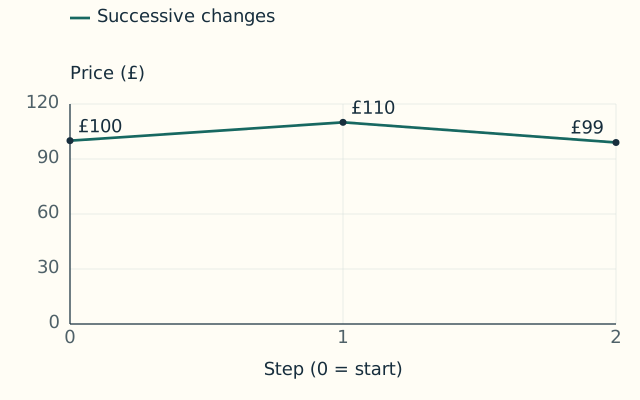
An invented price of £100 rises by 10% to £110. A subsequent 10% decrease removes £11, leaving £99. The second percentage uses a different base. The combined multiplier is 1.10 × 0.90 = 0.99, so the net movement is a 1% decrease, even though the stated percentages have equal sizes.

The second 10% change starts from £110, so the final value is £99.
Walkthrough and explanation

Slow down at the change of base. The first ten per cent is ten per cent of one hundred, which is ten. The second is ten per cent of one hundred and ten, which is eleven. Removing eleven after adding ten leaves us one pound below the start. This is why adding the signed percentages, plus ten and minus ten, gives the wrong answer for successive changes. Multipliers retain the changing base automatically. Equal increases and decreases are not reverse operations. To undo a known multiplier, divide by that multiplier rather than applying the same percentage with the opposite sign.

Next slide

Slide 7 / 14

Compounding builds on earlier changes

Compounding means applying each percentage change to the amount reached after the previous change. At a constant decimal rate r for n periods, final amount = initial amount × (1 + r)^n. The exponent n means repeated multiplication. With varying rates, multiply the separate period multipliers in sequence.

Walkthrough and explanation

An exponent is a compact way to record repeated multiplication: a multiplier squared means the multiplier times itself. Three periods require three copies. The percentage changes may describe output, costs or another quantity; compounding is a mathematical structure, not a promise about real-world performance. It differs from repeatedly adding the same original-base amount. Before using the formula, identify the length of each period and make sure the rate refers to that same period. An annual percentage cannot simply be relabelled as a monthly percentage. Fees, withdrawals, capacity limits or changing rates would need to be included separately in the model.

Next slide

Slide 8 / 14

Worked example: discount an illustrative price

A fictional item lists at £120. A 15% discount is applied first, followed by a 5% charge on the discounted price. Discount amount = £120 × 15/100 = £18. Discounted price = £120 − £18 = £102. Equivalently, £120 × 0.85 = £102. The next calculation must use £102 as its base.

Walkthrough and explanation

This question specifies the order and the base of the charge, so we do not need to guess how the seller calculates it. Begin with the discount. Fifteen divided by one hundred is zero point one five, and multiplying one hundred and twenty by that decimal gives eighteen pounds. Subtract eighteen from one hundred and twenty to get one hundred and two pounds. The multiplier route reaches the same intermediate value because eighty-five per cent remains. Write that intermediate value down clearly. The five-per-cent charge is attached to this discounted amount, rather than to the original list price.

Next slide

Slide 9 / 14

Worked example: apply the charge and compare

Charge = £102 × 0.05 = £5.10. Final price = £102 + £5.10 = £107.10. Combined multiplier = 0.85 × 1.05 = 0.8925. Net change = (107.10 − 120) ÷ 120 × 100 = −12.90 ÷ 120 × 100 = −10.75%. The final price is 10.75% below the original price.

Walkthrough and explanation

Five per cent of one hundred and two pounds is five pounds ten, so adding the charge produces one hundred and seven pounds ten. We then compare that final total with the original list price. The reduction is twelve pounds ninety, which is ten point seven five per cent of one hundred and twenty pounds. The combined multiplier provides a second check: zero point eight nine two five means the final amount is eighty-nine point two five per cent of the original. Its distance below one hundred per cent is ten point seven five percentage points on that original-price index.

Next slide

Slide 10 / 14

Worked example: set up repeated growth

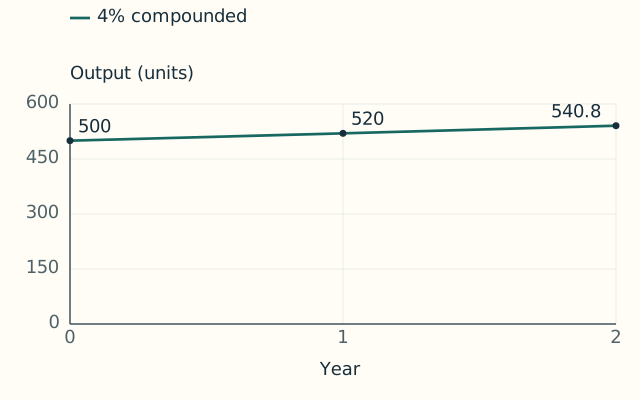
An invented planning model starts with 500 units of output. Output grows by 4% in each of two years, with each increase based on the previous year's output. The annual multiplier is 1 + 4/100 = 1.04. After year one: 500 × 1.04 = 520 units. The second year starts from 520.

Walkthrough and explanation

This is a deliberately simple model with a constant growth rate and no rounding to whole units. The units could describe a divisible measure of output, so fractional values are allowed. First turn four per cent into the decimal zero point zero four, then add one to include the original output. Multiplying five hundred by one point zero four gives five hundred and twenty. You can check that by finding four per cent of five hundred, which is twenty, and adding it to the start. The crucial next step is to use five hundred and twenty as the new base.

Next slide

Slide 11 / 14

Worked example: finish and measure total growth

Year-two increase = 520 × 0.04 = 20.8 units. Final output = 520 + 20.8 = 540.8 units. Equivalently, 500 × 1.04² = 500 × 1.0816 = 540.8. Overall percentage growth = (540.8 − 500) ÷ 500 × 100 = 8.16%. Adding 4% + 4% would miss growth on the earlier increase.

Output grows by 20 units first, then 20.8 units because the base has grown.
Walkthrough and explanation

The second increase is twenty point eight units, slightly larger than the first increase of twenty. That additional zero point eight is four per cent of the first year's extra twenty units. Adding the second increase to five hundred and twenty gives five hundred and forty point eight. To find the overall rate, return to the original five hundred-unit base. The gain of forty point eight divided by five hundred is zero point zero eight one six, or eight point one six per cent. Adding two lots of twenty would produce five hundred and forty, which corresponds to a different, non-compounded rule.

Next slide

Slide 12 / 14

Reverse a percentage change by dividing

If a value after a 15% increase is £69, the original value satisfies original × 1.15 = 69. Therefore original = 69 ÷ 1.15 = £60. Subtracting 15% of £69 would use the wrong base. For a known discount, divide the final value by the fraction of the original that remains.

Walkthrough and explanation

Working backwards means undoing the operation that produced the observed value. A fifteen-per-cent increase multiplies the original by one point one five, so division by one point one five reverses it. Sixty pounds is the result, and multiplying sixty by one point one five checks the answer. Do not remove fifteen per cent of sixty-nine: that would reverse a different operation based on sixty-nine itself. For a discount, the same logic applies with a multiplier below one. If a full one-hundred-per-cent discount leaves zero, however, the original cannot be recovered from that final zero alone.

Next slide

Slide 13 / 14

Report the base, period and rounding

A useful percentage statement identifies its base, its time period and whether the change is relative or measured in percentage points. Round only the final answer unless instructed otherwise. A large percentage increase can describe a small absolute change, so report the underlying amounts when they matter. Percentages alone cannot establish why a change occurred.

Walkthrough and explanation

Suppose a tiny activity doubles while a much larger activity grows only slightly. The tiny activity has the larger percentage increase, but it may still add fewer units. This is why absolute changes and relative changes often belong together. Time periods matter too: a growth figure for one month cannot be compared fairly with a whole-year figure without additional analysis. When rounding a repeated calculation, keep the full intermediate values so that early rounding does not accumulate. Finally, a percentage describes a relationship between numbers. It does not show whether a policy, a price change or some other event caused the movement.

Next slide

Slide 14 / 14

A reliable percentage decision tree

Ask what the question wants. A share requires base × decimal percentage. A new amount requires a multiplier. A percentage change requires change ÷ original × 100. A change between percentage levels may require percentage points. Successive changes require multiplied factors. Recovering an original value requires dividing by the known multiplier.

Walkthrough and explanation

Before attempting the exercises, practise choosing the operation in words. Are you finding part of a whole, moving a quantity forwards, comparing endpoints, or working backwards? Those are different tasks even when the same percentage appears in the question. Write the base next to each calculation and label percentage-point answers explicitly. For successive changes, a small timeline can help: starting amount, first new amount, final amount. Check the final answer against a combined multiplier. Enter a percentage such as seven point five as 7.5 when the field already displays the percent unit, rather than entering its decimal multiplier.

Go to the exercises

Questions students ask

This guided dialogue explains common sticking points. It is written teaching material, not a live chat service.

Why do we divide percentage change by the original value?

The question measures the movement relative to the starting position. Dividing by the final value answers a different question. Label the starting value before calculating, especially when a change is reversed.

Are percentage points just a more formal name for percentages?

No. Percentage points measure the direct difference between percentage levels. A percentage change divides that difference by the original level and expresses the result per hundred.

Can a percentage exceed 100%?

Yes. A quantity can be more than the whole used for comparison, and an increase can exceed the original amount. But a share of one ordinary non-negative whole cannot exceed 100% without overlapping categories or a different interpretation.

Does changing the order of two percentage multipliers always change the result?

Two pure multiplicative changes on the evolving amount give the same final product in either order. However, fixed charges, thresholds, rounding rules or percentages attached to specified original bases can make real arrangements behave differently.

Why keep extra digits until the end?

Rounding changes the value slightly. Reusing a rounded intermediate value can carry that difference into later steps. Keep the available precision during the calculation, then round to the accuracy the question requests.

Apply the lesson

Your exercises

Use the worked examples to learn the method, then submit these different problems. Numerical and choice answers are checked on the server. Written reasoning is saved for your own review and receives no automatic mark.

Your learning account

You can study every lesson and prepare your answers without an account. Signing in enables private submissions when the service is available.

1. Calculate a maintenance share

An invented £350 budget allocates 18% to maintenance. How many pounds are allocated to maintenance?

Calculate a maintenance share answers

Answers stay in this tab until you submit. This form does not store drafts on your device.

2. Measure a price increase

A fictional price rises from £84 to £96. Give the absolute increase in pounds, then the percentage increase relative to the original price. Round the percentage to two decimal places.

Measure a price increase answers

Answers stay in this tab until you submit. This form does not store drafts on your device.

3. Distinguish two descriptions of a rate change

In an invented survey, a participation rate rises from 12% to 15%. Give the increase in percentage points and the relative percentage increase. Both requested increases are positive.

Distinguish two descriptions of a rate change answers

Answers stay in this tab until you submit. This form does not store drafts on your device.

4. Apply successive changes

An illustrative price begins at £240. It increases by 10%, then decreases by 5% of the increased price. Find the final price and the net percentage change from the starting price. Enter a positive net percentage for an increase or a negative one for a decrease. Give the price to two decimal places.

Apply successive changes answers

Answers stay in this tab until you submit. This form does not store drafts on your device.

5. Recover a price before a discount

A fictional item has a price of £64 after a 20% discount. What was the price immediately before that discount? There are no other charges.

Recover a price before a discount answers

Answers stay in this tab until you submit. This form does not store drafts on your device.

Your recent submissions

Only submissions for this lesson appear here. Your account export includes your saved attempts.